Sunday, April 11, 2010

World Cultural Preservation

My former professor, Richard Kurin, has been the Under Secretary for History, Art, and Culture" at the Smithsonian Institution for over 25 years now. An interview with Dr. Kurin posted on the U.S. State Department's propaganda organ America.gov has been making the round among progressive news outlets like Scoop and cultural resources blogs like Saving Antiquities.

I am amazed that Kurin has not only survived but flourished as organizer and recruiter of international acts for the Smithsonian Folklife Festival as well as many of the Silk Road Project events and exhibits at museums in our nation's capitol. The profile advertising his appearance at the Canadian Museum Association conference in St. Johns, Newfoundland, Kurin describes many of his most recent accomplishments:
(Kurin)... has worked with cultural figures ranging from Pete Seeger, Yo-Yo Ma, Mickey Hart, and Bernice Johnson Reagon to the Aga Khan and the Dalai Lama. He helped draft an international treaty on safeguarding the world’s living cultural heritage. He has produced major events for the Smithsonian’s 150th anniversary, the opening of the World War II Memorial, the opening of the National Museum of the American Indian, and programs for numerous presidential inaugurals, including that of President Obama.
I highly recommend the interview with Kurin posted at America.gov.

Labels: , , , , , , , , , , ,

Sunday, August 23, 2009

EPA damages Fort Edward

This story is over a week old, but it is only just now beginning to show up on listservers and blogs about archaeology and historic preservation.

Fort Edward is located on the east bank of the Hudson River 45 miles north of Albany, New York. It strategic importance lay in serving as a point of portage between the Hudson River and Lake George. Fort Edward figured prominently in the history of the French and Indian War and the American Revolution. The fort's location is also within the area initially impacted by PCB wastes which were left behind by General Electric and were eventually washed downstream to contaminate the entire Hudson River valley and its estuary, where New York City is located.

The current chapter in Fort Edward's long and colorful history began when the Environmental Protection Agency restarted its project to dredge the entire Hudson River downstream of the spill. The dredging project had been strongly debated both pro and con for many years, and the environmentalist forces marshalled by the likes of Pete Seeger and Robert Kennedy, Jr. finally achieved their goal. Now some clumsy equipment operators appear to have ripped out timbers from an historic fort, triggering severe bank erosion. Conservative news outlest such as CNS News and Rupert Murdock's New York Post have jumped on the story, presumably because it casts the EPA in a bad light. Historic preservationists must regrettably admit that the fort site itself had been poorly maintained. Archaeological consultants working for EPA may have given inadequate guidance regarding the fort's extent, condition, and appropriate measures for dredging in the immediate vicinity.

Hat tip to New York History blogger John Warren, whose excellent writing just came to my attention while researching this story.

Labels: , , , , ,

Monday, August 10, 2009

Restoring the Arch of Ctesiphon?

The U.S. military plans to assist regional Iraqi autorities in the "restoration" of a ruined brick arch. According to the story written by Pvt. Jared Gehmann of the 82nd Airborne, the Arch of Ctesiphon was built nearly 16 centuries ago and was formerly a popular tourist attraction in this part of Iraq.

Labels: , , , , , , , ,

Wednesday, March 18, 2009


My call to Nori Jung on her show, "Norivision." The show airs Friday nights at 8:30 PM on the Manhattan Neighborhood Network.

Labels: , ,

Friday, July 04, 2008

No Looting In Iraq?

It all started with a story by Martin Bailey in The Art Newspaper, and it was really the headline as much as the actual story that drew fire. As reported by Mr. Bailey,
An international team of archaeologists which made an unpublicised visit to southern Iraq last month found no evidence of recent looting—contrary to long-expressed claims about sustained illegal digging at major sites.

Mr. Bailey did also mention that the archaeologists only visited eight major sites in southern Iraq: Ur, Ubaid, Eridu, Warka, Larsa, Tell el-Ouelli, Lagash and Tell el-Lahm. However, he also clearly expressed his view that the extent of looting has been exaggerated both by reporters and by archaeologists. A similar view has been even more directly expressed in a blog commentary by Dr. Dorothy King -
The false claim of looting - along with the claim that the US could have prevented the thefts from Baghdad Museum - has been a major part of the anti-War propaganda.
Whether pro- or anti-war, it is clear that propaganda and political advocacy do color our perception of the illegal digging and trade in antiquities which have occurred both before and after the United States deposed Saddam Hussein by military force. Issues about protection of cultural resources cannot be separated from political and military issues in Iraq and other countries of the Middle East. Archaeology and protection of cultural resources are deeply embedded within the ongoing political and religious conflicts.

Relying both upon her own inspection of aerial photographs and upon research by Dr. Elizabeth Stone, Dr. King supports the gist of the Bailey piece in concluding that most looting on the major sites occurred prior to the start of the current Iraq war. Opposing views on the issue are being expressed, however, by David Gill, Larry Rothfield, and a number of other scholars posting to the Iraq Crisis discussion list. A first hand account of looting in southern Iraq presented by the Director of Antiquities in Nasiriya Province, Dr. Abdulamir Hamdani, can be viewed online at Safe Corner.

What a blogstorm!

Labels: , , , , ,

Tuesday, July 01, 2008

Save the Torahs?

Jewish manuscripts smuggled out of Iraq since the fall of Saddam are a current topic of active discussion among archaeologists, artifact collectors, and legal experts on the Iraq Crisis discussion list. One of the stories which sparked this discussion is about Rabbi Menachem Youlus, pictured here.

A recent article by Caroline Prince in the Christian Science Monitor describes Rabbi Youlus as the "Indiana Jones" of Rabbis. That he very well may be, for as we have only recently learned, the fictional Indy is no professional but rather a "plunderer." As reported in the Jewish Bugle, Rabbi Youlus is reported to have sold a Torah "liberated" by a United States soldier to a synogogue in Fulton, Maryland for $20,000. In order for the object to be smuggled out of Iraq, it first had to be "dissassembled" into 60 panels. Rabbi Younus also mentioned to the Jewish Bugle reporter some unusual methods of "restoration" -

"Normally we write with a turkey feather or a goose feather, but you can't use it with that type of parchment," said Youlus, explaining he had to use a piece of wood resembling a chopstick.

"It was plenty of work. But the finished product is very nice," he said.

Labels: , , ,

Sunday, May 18, 2008

Death of Roxana Brown

Dr. Roxana Brown, an expert on southeast Asian ceramics who lived in Bangkok, Thailand, died while in custody in a Seattle prison on Wednesday morning. Dr. Brown had been arrested for a single count of wire fraud, the first arrest to come out of the federal government's aggressive probe into the antiquities trade and donations to Los Angeles museums. According to a story in today's Seattle Post-Intelligencer, Dr. Brown died of peritonitis from a perforated gastric ulcer. Her brother, Dr Fred Brown of Chicago, previously reported that she died of a heart attack which he believed was brought about by the stress of her arrest.

Dr. Brown was the director of the Southeast Asian Ceramics Museum at Bangkok University in Thailand, and she had been confined to a wheelchair after losing her leg in the 1980s. She was in Seattle visiting family as she prepared to speak before an academic conference.

Federal investigators asserted Wednesday that Dr. Brown allowed her electronic signature to be placed on appraisal forms that were part of a tax fraud scheme in California. The perpetrator of the tax fraud scheme, Jonathan Markell, operated the private gallery "Silk Roads." Markell allegedly inflated the value of ceramic artifacts donated to museums, allowing collectors to claim fraudulent tax deductions. Archaeologists and museum curators interviewed in Thailand by the Bangkok Post expressed considerable skepticism regarding the evidence so far presented against Dr. Brown.

Derek Fincham gives some of the back story of the federal antiquities probe in his post at Illicit Cultural Property.
I also wrote a previous post in this blog about the museum raids back on January 27th.

Labels: , , ,

Tuesday, September 04, 2007

Sicilian marble scandal at the University of Virginia

The University of Virginia Art Museum is currently exhibiting "Acrolith" sculptures which were purportedly looted from the Hellenic site of Aidone on the island of Sicily. The Italian government's efforts to retrieve these artifacts has recently been reported in the New York Times and in the university's student newspaper, The Cavalier. Although many of the details are still unknown, the story which Italian prosecutor Silvio Raffiotta tells of how these artifacts made their way from Sicily into private collections reads like a good detective novel:

(The acroliths) were illegally excavated by tomb robbers in Morgantina in the late 1970s. They are believed to represent the goddesses Demeter and Persephone, whose cult was deeply rooted in Morgantina, which fell to the Romans in 211 B.C. In all, two heads, three feet and three hands were found; the body, most likely made of wood, might not have survived the centuries underground.

In a 1988 deposition, Giuseppe Mascara, a former tomb robber and antiquities dealer, told Mr. Raffiotta that in the spring of 1979 a young man had offered to sell him the two marble heads, which he said had been excavated in Morgantina.

“They were in the trunk of a car,” Mr. Mascara said in the deposition, and of “exceptional make.” But he did not buy them “because I didn’t know the man offering them to me and because of the asking price, which was enormous.”

Vincenzo Cammarata, another antiquities dealer who has been investigated for handling looted objects, also testified that he had been shown the acroliths, in the summer of 1979.

Mr. Raffiotta’s investigations began some years later and tracked the acroliths to the London showroom of the antiquities dealer Robin Symes, who is being investigated in Italy for dealing in looted art. Before arriving in London, the objects moved through Switzerland, a typical route used to disguise provenance.


Mr Raffiotta's reconstructed "chain of title" for the artifacts ends in 1980, when Mr. Symes sold the acroliths for a reported $1 million to Maurice Tempelsman. Templelsman, a Belgian-American diamond merchant more commonly known as the long-time companion of Jacqueline Kennedy, is believed to be the current owner. The University of Virginia Art Museum is apparently acting as a broker between Mr. Tempelsman and the Italian government as he endeavors to return the artifacts after a five year period during which they are being authenticated and appraised.

I was made aware of this interesting albeit sad story of international thievery and academic intrigue by Derek Fincham who writes the blog Illicit Cultural Property. Fincham also posted the photograph of the acroliths which appears at the top of this post.


Labels: , ,

Wednesday, June 27, 2007

Reconstruction of the Al Askari shrine

A Memorandum of Understanding was signed by UNESCO and the Government of Iraq on Sunday, June 24th, 2007 for the reconstruction of the Al-Askari shrine. With a total budget of $8.4 million, the first phase of the project includes preventive works, an assessment of needs, and preparation of a scope of work for the restoration. In addition to the shrine’s Golden Dome and Ali al-Hadi shrine, the two minarets destroyed in the recent explosions on June 13th will be reconstructed. Alhamdulillah!

Labels: , , , ,

Wednesday, March 07, 2007


Fighting for Iraq's Culture

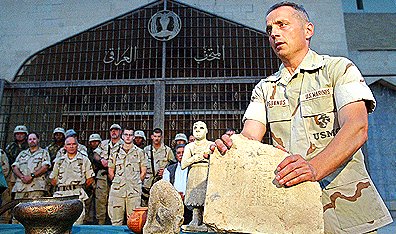
Colonel Matthew Bogdanos, author of Thieves of Baghdad, had an op-ed piece in yesterday's New York Times1 repeating his call for Europe to do more to crack down on the trade in antiquities looted from Iraq since the beginning of the U.S. invasion. He also advances a new challenge to European archaeologists to have their nations recruit guards for the archaeological sites which they have excavated.

I do not expect much to come of Bogdanos' proposal, and I doubt that he expects or wants much from the Europeans himself. As Bogdanos notes, providing security for archaeological sites would be viewed by the Iraqis, Iraqi expatriates, and the rest of the world as a statement in support of the war. We should however acknowledge the assistance of both Poland and the Czech Republic in providing professional archaeologists and experts in cultural property.

Bogdano calls for a humanitarian effort to protect a cultural heritage rich with common ancestry that predates the splits among Kurd, Sunni Arab and Shiite. This is a noble proposal but one which I am certain he himself recognizes will fall on deaf ears given that it comes from a colonel in the U.S. Marine reserves. We can only hope that cultural treasures like the "Lion attacking a Nubian" shown above will be well cared for by whatever museum or private collector manages to obtain them through the illegal antiquities trade.


1Bogdanos, Matthew, 2007, "Fighting for Iraq's Culture," New York Times, March 6.

Labels: , , , ,

Thursday, December 14, 2006

Stolen Iraqi treasure sold at auction in Munich

Two stolen ancient Sumerian artefacts exhibited in a Munich art auction house and on the internet were sold on Tuesday, according to a Deutsche Presse-Agentur release. Although the legality of the auction was challenged by Iraqi authorities, German customs officials said the Munich sale had already taken place and could not be stopped. One item sold was a 227-millimetre-tall, headless limestone statue of a Sumerian man that dates back to 2500 BC. The other was an 117mm-long nail made of clay which bears Sumerian inscriptions dating back to King Shulagi of the Ur dynasty in 2097 - 2095 BC.

There is a "red list" posted here of artifacts that may be finding their way onto the antiquities market from Iraq, either stolen out of the Iraqi National Museum or looted from unprotected archaeological sites. There is also a partial list of artifacts stolen from the Iraqi National Museum on the webpage of the Oriental Institute of the University of Chicago.

Labels: , , , , ,

Sunday, October 15, 2006


Matthew Bogdanos Lecture

Matthew Bogdanos, US Marine Officer and Author of Thieves of Baghdad will present a lecture on Monday, October 16th, 2006 at 4:00 PM in Room 248, Student Learning Center, University of Georgia. Mr. Bogdanos will be speaking about his investigation of the looting of the Baghdad museum and the current state of affairs with looting and conservation of archaeological material in Baghdad and Iraq. A book-signing and reception will follow the lecture, which is sponsored by the Wilson Center for Humanities and Arts, the Center for Archaeological Sciences, and the Department of Classics at the University of Georgia.


I am looking forward to this, although I expect that it will be too crowded to pose many questions or have much discussion. I wonder what Bogdanos will have to say about the recent departure from Iraq of the former museum curator, Donny George.

Labels: , , ,